scheme-langserver

Scheme-langserver

You may read my paper and cite like this:
WANG, Z. (2025, May 12). Scheme-langserver: Treat Scheme Code Editing as the First-Class Concern. The 18th European Lisp Symposium (ELS`25), Zurich. https://doi.org/10.5281/zenodo.15384882
Due to occasional GitHub access restrictions from China, this repository is also mirrored on Codeberg and Gitee. I collaborate with XmacsLabs; a fork is available here.
VSCode is now supported! See the setup guide.
Note: Auto-generated type information is available here. It is mainly used for downstream development and debugging.
Implementing IDE features like autocomplete, goto definition, and hover documentation is a significant effort. Compared to languages like Java, Python, JavaScript, or C, language server implementations for Lisp dialects are still scarce. Existing tools such as Geiser, racket langserver, and swish-lint rely primarily on a REPL or keyword tokenization rather than static program analysis.
For example, when editing an incomplete project whose code is not yet fully executable, Geiser can only complete top-level bindings listed by environment-symbols (on Chez Scheme) or raw symbols—not true identifiers. This means local bindings and unfinished code receive no help in recognizing valid identifier scopes. The same limitation applies to goto definition and other core IDE features.
The root cause is that Scheme and other Lisp dialects present a formidable challenge for program analysis: their rich data structures, flexible control flow, and especially macros make static reasoning difficult. But this does not mean Scheme is only for geniuses and meta-programming. With a better editing environment, Scheme can be accessible and productive for everyone.
scheme-langserver is a Language Server Protocol (LSP) implementation for Scheme that provides completion, goto definition, hover, and type inference through static code analysis based on the R6RS standard, with switchable top environments for R6RS, R7RS, S7, and Fluent Scheme (Ansys Fluent’s embedded Petite Chez Scheme). It handles incomplete code gracefully and is published via Akku, a Scheme package manager.
The server has been tested on Chez Scheme 9.4, 9.5, and 10.x.
Compilation, Installation & Configuration
See the setup guide.
Workspace Cache
scheme-langserver can persist the analyzed workspace state to a Chez FASL cache so
that subsequent restarts skip the expensive init-references phase. Enable it
with the --cache-path option:
./run --cache-path ~/.cache/scheme-langserver
The cache file is written to <cache-path>/workspace.fasl. It is saved when the
server receives a normal LSP exit or shutdown request; if the process
crashes or is killed, the previously saved cache remains usable. The cache is
keyed by a manifest that includes the langserver version, Chez version, machine
type, and record-layout fingerprint; any mismatch falls back to a cold start.
Because Chez FASL is platform-specific, do not share the cache file across
machines or Chez versions. When only a few files have changed since the cache
was saved, the server performs an incremental refresh and preserves the analysis
results for unchanged files.
Typical speedups:
| Fixture | Cold startup | Cached startup | Speedup |
|---|---|---|---|
| simple-lib | ~31 ms | ~1.3 ms | ~24x |
| Synthetic 200-file fixture | ~2484 ms | ~49 ms | ~50x |
scheme-langserver itself (128 .sls files) |
~55,790 ms | ~1750 ms | ~32x |
| scheme-langserver, one file changed | ~58,846 ms | ~1900 ms | ~31x |
See doc/analysis/workspace.md §8 and AGENTS.md §11 for implementation details.
File Filter
By default scheme-langserver uses the Akku package manager’s file list to decide which files belong to the workspace. For projects without Akku, or for non-standard file extensions, choose one of the following mutually exclusive options:
-
--package-manager(or-p) selects a preset:./run -p akku # Akku-managed files (default) ./run -p txt # Only .scm.txt files -
--file-filter(or-f) gives an exact extension list. It can be repeated and the extensions are merged automatically; leading dots are optional:./run -f ".sls,.scm,.ss,.sld,.scm.txt" ./run -f scm.txt -f scm -f sls ./run -f sls -f scm -f sps -f ss -f sld
-p and -f cannot be used together. The resolved filter is persisted in the
workspace-cache manifest, so changing the filter invalidates any previously saved
cache.
Debugging
For troubleshooting tips, see debugging.md.
Release
2.1.10 — Bug-fix release hardening the tokenizer: files with content after #!eof and files whose first datum is not a parenthesized form no longer fail the whole workspace initialize; adds the Fluent Scheme top environment.
Active development is focused on bug fixes, performance profiling, and expanding the type inference system.
See doc/release-history.md for older releases.
Features
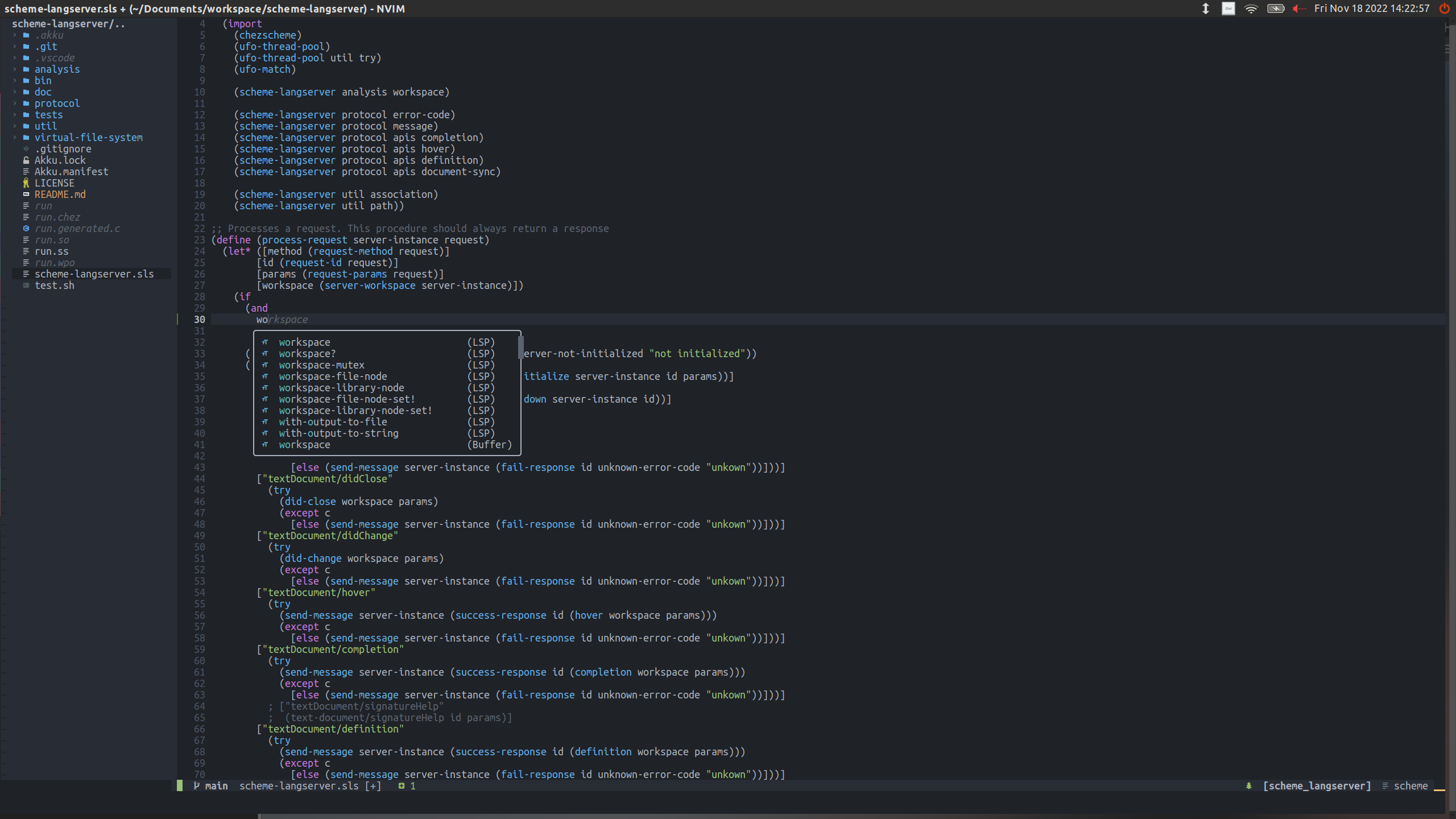
- Completion for top-level and local identifier bindings.
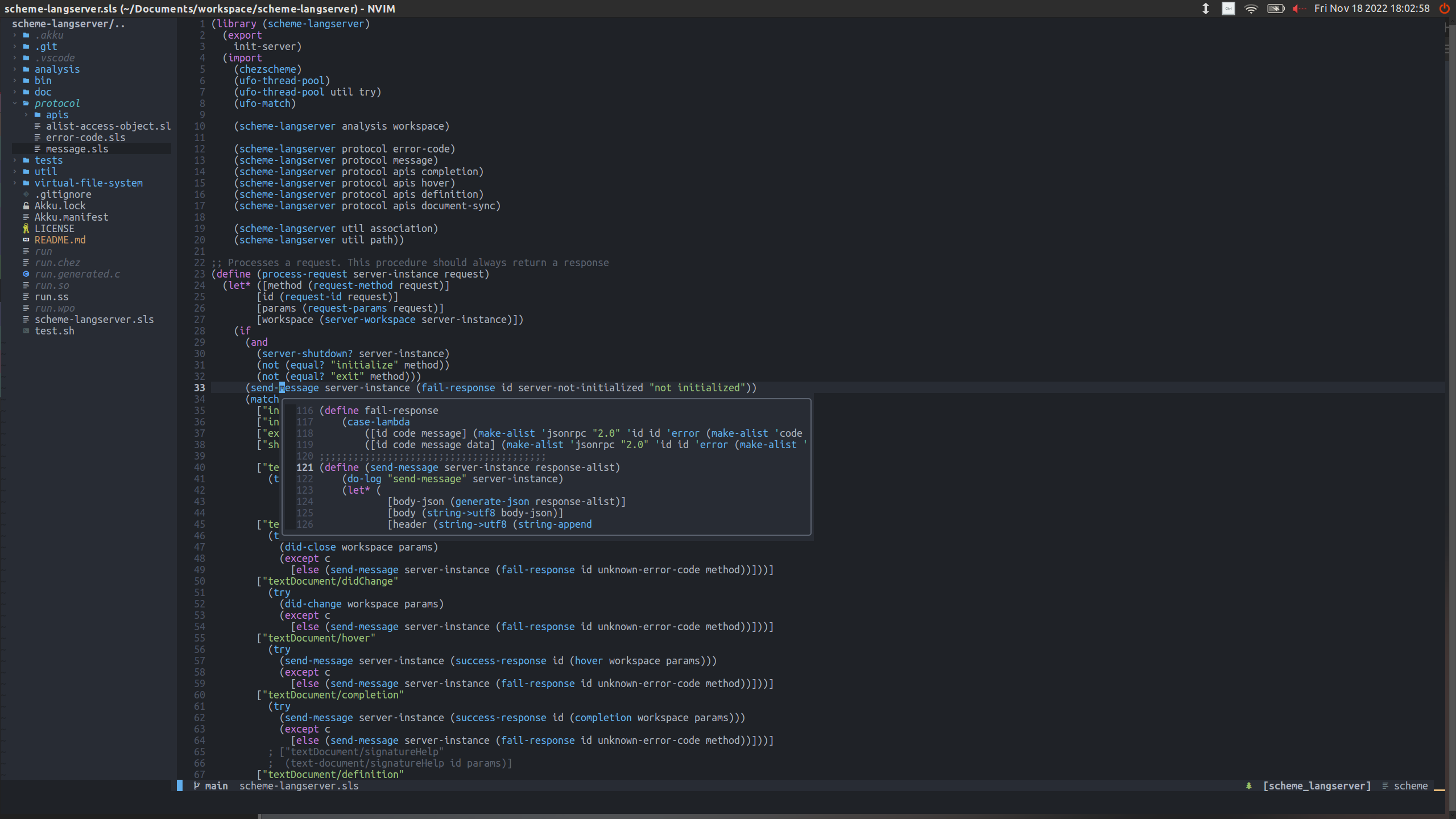
- Goto definition.
- Compatible with package manager: Akku.
- File-change synchronization with corresponding index updates.
- Hover.
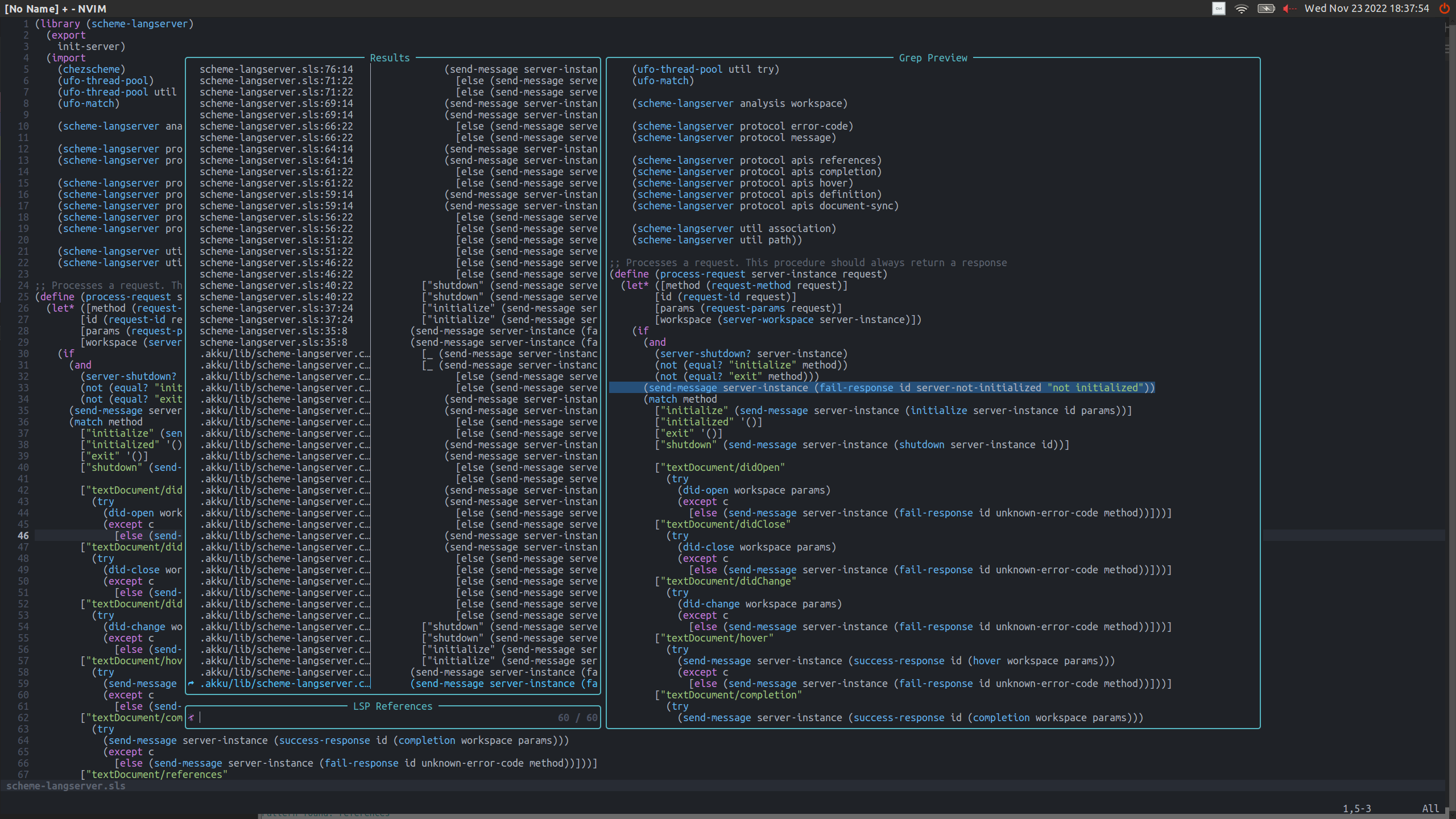
- References and document highlights (document-scoped).
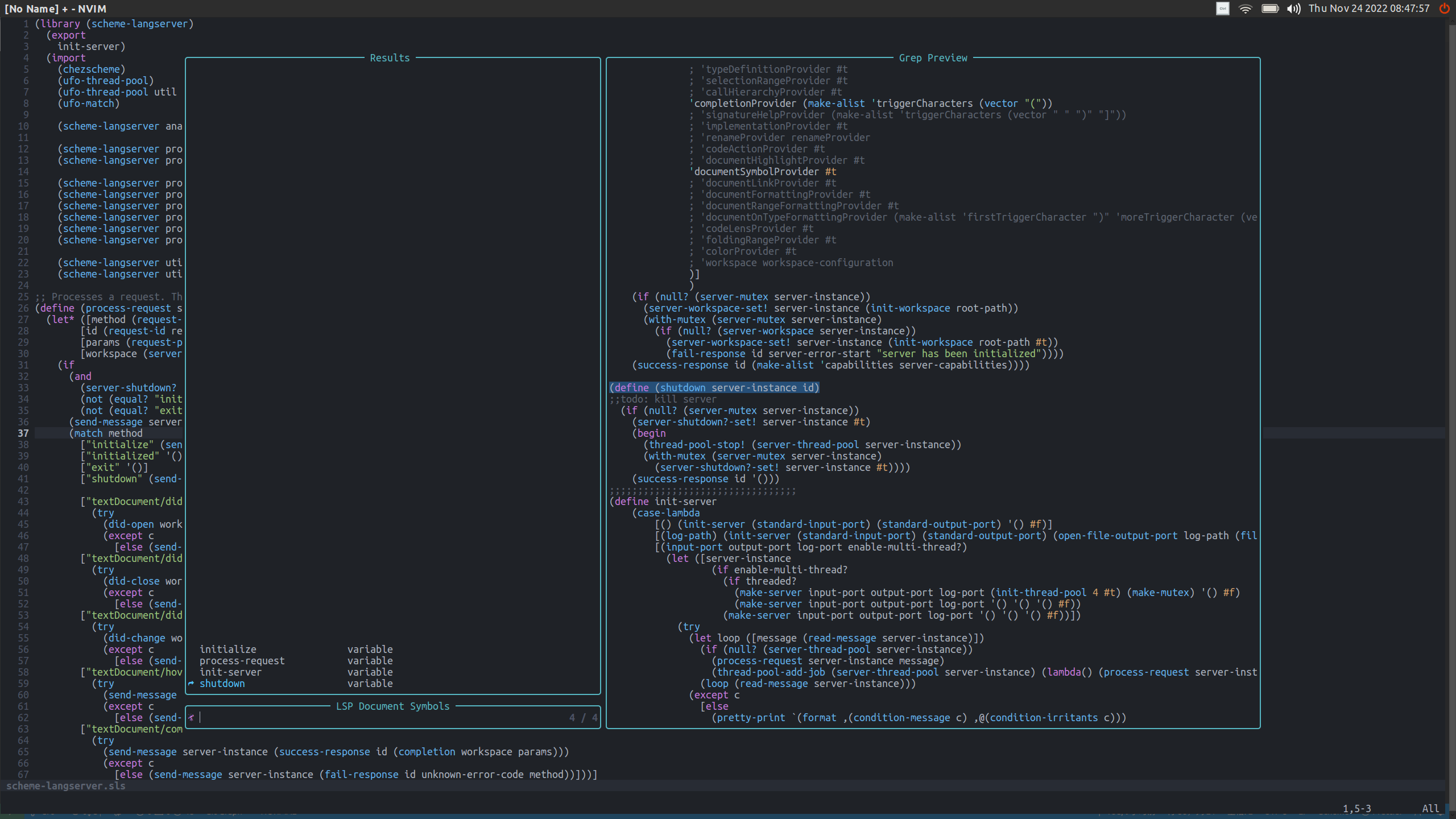
- Document symbol.
- Workspace symbol search (
workspace/symbol). - Catching local identifier bindings in
define-syntax,let-syntax, and other macro forms via hand-written rules. - Automatic macro resolution (experimental). The generic expander for
syntax-rules,syntax-case,let-syntax, andletrec-syntax—plus multi-layer macro cascade propagation—is functionally correct but not enabled in production because it is too slow for real-world projects (it triggers heavy macro expansion and cross-document reference back-propagation for every macro use site). The routing code inanalysis/identifier/self-defined-rules/router.slscurrently falls back to hand-written rules such asmatch-processforufo-match. If you are interested in pushing this research forward—e.g. via lazy expansion, incremental caching, or selective rule generation—contributions and discussions are very welcome! - Cross-platform parallel indexing.
- Custom source-code annotator compatible with
.spsfiles. - Peephole optimization for API requests using suspendable tasks.
- Type inference via a homemade DSL interpreter, now integrated into auto-completion. Parameters whose types match the expected signature are ranked higher, as shown below where
length-aandlength-b(bothinteger?) appear first because they match the parameter type required by<=.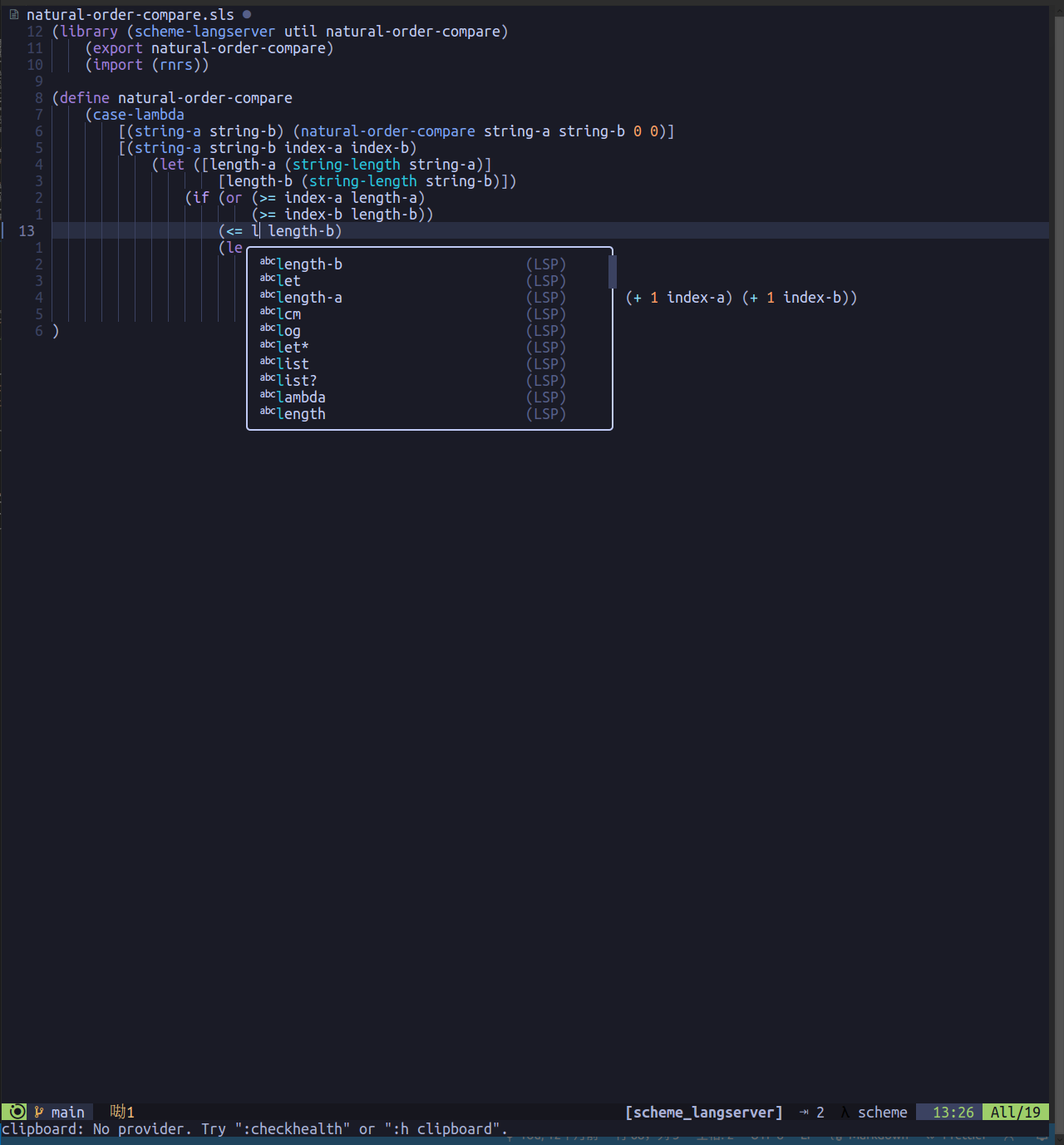
- Supports R6RS, R7RS, S7, and Fluent Scheme (Ansys Fluent’s embedded Petite Chez Scheme) by switching top environments.
send-message
2023 11 21 11 26 41 967266866
{"jsonrpc":"2.0","id":"3","result":[{"label":"length-a"},{"label":"length-b"},{"label":"lambda"},{"label":"latin-1-codec"},{"label":"lcm"},{"label":"least-fixnum"},{"label":"length"},{"label":"let"},{"label":"let*"},{"label":"let*-values"},{"label":"let-syntax"},{"label":"let-values"},{"label":"letrec"},{"label":"letrec*"},{"label":"letrec-syntax"},{"label":"lexical-violation?"},{"label":"list"},{"label":"list->string"},{"label":"list->vector"},{"label":"list-ref"},{"label":"list-sort"},{"label":"list-tail"},{"label":"list?"},{"label":"log"},{"label":"lookahead-char"},{"label":"lookahead-u8"}]}
- Abstract interpreter that resolves identifiers across multiple file extensions:
.scm,.ss,.sps,.sls,.sld. - Code diagnostics with LSP-standard
sourceandcodefields. Detects library-not-found, duplicate identifiers in binding forms (e.g.(lambda (x x) ...)), unused imports (e.g.(only (rnrs) car)wherecaris never referenced), and tokenizer syntax errors.
Roadmap
- Renaming support (
textDocument/rename+prepareRename). - Formatting (
textDocument/formatting). - Signature help (
textDocument/signatureHelp). - Code actions (
textDocument/codeAction) — e.g. “Remove unused import”, “Organize imports”. - Full R6RS compatibility.
- Step-by-step macro expander for self-defined macros.
- Code evaluation within the language server.
- Cross-language semantic support via AST transformers.
- Extract expression/statement into a procedure (refactoring).
Contributing
Pull requests are welcome! Please see AGENTS.md for project conventions, build steps, and coding style before opening a PR.
Vibe Coding with KIMI
Since mid-2025, active development on this project has been assisted by KIMI (Moonshot AI) in a vibe-coding workflow: the maintainer describes intent in natural language, KIMI explores the codebase, proposes changes, and iterates with tests. If you notice commits authored or co-authored by kimi, that is the AI agent trail. Human review and final approval always remain with the maintainer.
Testing
Almost all key procedures and APIs are covered by tests. Run the full suite with:
bash test.sh
For faster feedback during development, run a single test file:
source .akku/bin/activate
scheme --script tests/protocol/apis/test-definition.sps
Note: Tests currently focus on single-threaded execution. Note:
tests/robustness/robustness-concurrent.sps(multi-threaded) used to fail intermittently withException in thread-loop: ... no fail-handlerfollowed by a hang. The root cause was a non-tail-recursive wait loop inrequest-queue-pop(each recursive frame dequeued again, consuming tasks twice), diagnosed via cisco/ChezScheme#1055. Fixed in 2.1.10.
Other Use Cases
Script-Fu in GIMP
Script-Fu is based on Scheme. Using this example, you can apply scheme-langserver to .scm files in GIMP.
Other Potential Targets
Possible future targets include OMN (Opusmodus Notation) and AutoLisp.
Code Count
find . -name "*.sls" ! -path "./.akku/*" |xargs wc -l
Detailed Document
Core Analysis
- Catching identifier bindings — how the abstract interpreter resolves
define,lambda,let,define-record-type, etc. - Macro auto-resolution — generic
syntax-rulesexpansion vs hand-written rules - Type system & inference — complete type-inference pipeline and DSL
- Workspace lifecycle — initialization, incremental updates, and refresh batches
- File dependency graph — topological sorting and linkage matrix
Protocol & Concurrency
- API request scheduling — request queue, engine time-slicing, cancellation, and document-sync protection
- Diagnostic publication — how diagnostics are generated, accumulated, and sent
Debugging & Development
- Debugging guide — enable logs, replay logs, and iterative printf debugging
- Development guide (中文) / English version
- AGENTS.md — build steps, testing conventions, coding style, and common traps for contributors
User Guides
- Fluent Scheme support — using Magic Scheme + scheme-langserver for Ansys Fluent Scheme development in VS Code (中文版)
Research & Experiments
- Scheme-langserver paper (ELS’25) — academic paper on static analysis for Scheme
- Macro resolution notes — debugging notes for macro identifier capture
- Syntax candy DSL — pattern matcher for type-rule authoring
- Record type inference analysis —
define-record-typein the type system - Type inference benchmark — performance measurement methodology
- DeepWiki