scheme-langserver
How scheme-langserver schedules and analyzes API requests
In multi-threaded mode, scheme-langserver uses a single-consumer request queue to process LSP requests serially, and leverages Chez Scheme’s engine mechanism to assign preemptible time slices (ticks) to each task. This balances long-running analysis (such as type inference) with document consistency.
Note: The “peephole optimization merging didChange” strategy mentioned in the old document no longer exists in the current implementation. The current queue uses a model of strict serial execution + task deduplication/cancellation.
1. Threading model overview
The server initializes the following components only when both enable-multi-thread? and the internal threaded? flag are true:
- Thread pool: size 2 (provided by
ufo-thread-pool). - Request queue:
make-request-queuecreates a queue with a mutex and a condition variable. - Interval timer: an
interval-timerthat pushes an internal notificationprivate:publish-diagnosticsinto the queue once per second.
Key design: despite the name “multi-threaded”, there is effectively only one worker thread dedicated to consuming the request queue (the other thread typically serves the timer). The main thread (I/O thread) reads LSP JSON-RPC messages from standard input and calls request-queue-push to enqueue them. Therefore, all requests are processed serially rather than in parallel, which naturally avoids most data races.
2. Request queue structure
A request-queue consists of the following parts:
| Field | Description |
|---|---|
mutex |
Mutex protecting the queue and tickal-task-list |
condition |
Condition variable on which the worker thread waits when the queue is empty |
queue |
Underlying slib queue, holding pending tickal-tasks |
tickal-task-list |
List of all enqueued or running tasks, used for lookup, deduplication, and cancellation |
Why a linked list instead of a hash table?
request-idis not guaranteed to be unique. A client may send multiple requests with the sameid(e.g., retries after a timeout), or the server may internally reuse IDs. A hash table keyed byidwould either overwrite earlier tasks or require complex multi-value handling. A simple list withfind/remqcorrectly handles duplicates at the small scale typical of an LSP request queue (usually < 10 items).
3. Tickal task and engine mechanism
Every enqueued LSP request is wrapped as a tickal-task and executed via Chez Scheme’s make-engine. An engine is a continuation-based cooperative multitasking primitive:
- Time slice: each task is initially allocated
ticks = 100000computation credits. - Completion callback (
complete): called when the task finishes normally within its time slice; removes the task fromtickal-task-list. - Expiration callback (
expire): called when the task exhausts its time slice; decides whether to continue running or terminate.
((make-engine job) ticks complete expire)
Design purpose: expire is mainly aimed at long-running background analysis (for example, type inference). When type inference exhausts its time slice, the engine triggers expire, at which point it can check whether the task has been cancelled by the client (stop?), thereby avoiding blocking the queue with useless computation.
4. Enqueue strategy and priority control
request-queue-push adopts different enqueue logic depending on the request method:
4.1 private:publish-diagnostics (internal diagnostic publication)
- Deduplication: if a task of the same kind already exists in
tickal-task-list, it is not enqueued again. - This task is triggered once per second by the interval timer and is used to send accumulated diagnostic information to the client.
4.2 $/cancelRequest (cancellation request)
- Locates the target request in
tickal-task-listaccording toparams.id. - Sets the target task’s
stop?flag to#t. - Calls
potential-request-processorto process the cancellation request itself (usually sending a cancellation acknowledgement to the client). - The cancelled task will be safely removed on the next
expire, after acquiringworkspace-mutex.
4.3 textDocument/didChange (document change)
- If there is a pending
private:publish-diagnosticstask in the queue, it is immediately marked asstop?(the document has changed, so the old diagnostics are no longer valid). - Then
didChangeitself is enqueued as a newtickal-task.
4.4 All other requests
- A new
tickal-taskis created and enqueued directly.
5. Special protection for document synchronization requests
LSP document synchronization requests (textDocument/didOpen, textDocument/didChange, textDocument/didClose) enjoy non-interruptible privilege in the expire callback:
[(or (equal? "textDocument/didChange" ...)
     (equal? "textDocument/didOpen" ...)
     (equal? "textDocument/didClose" ...))
  (remains ticks complete expire)]
- When these requests exhaust their time slice, they do not stop; instead they are immediately recharged via
(remains ticks ...)and continue executing. - This guarantees that the server-side document state always stays strictly consistent with the client, and will not suffer from half-finished index updates due to time-slice expiration.
The comment in the source specifically states:
expireshould not interrupt the workspace refreshing procedure; its primary goal is to interrupt type inference and similar reentrant pure-computation tasks.
6. Consumer side: worker thread loop
request-queue-pop pops a tickal-task from the head of the queue under mutex protection. If the queue is empty, it blocks via condition-wait until push signals condition-signal.
The popped task is not executed immediately; instead a thunk (parameterless function) is returned. The worker thread calls this thunk in a loop, and the thunk starts the engine internally:
(lambda ()
  ((make-engine job) ticks (tickal-task-complete task) (tickal-task-expire task)))
This indirection decouples the synchronization primitives (mutex/condition) of request-queue-pop from the actual execution environment (engine/thread) of the task.
7. Interplay between mutex, engine time slice, and LSP cancelable tasks
This section explains how the queue-level mutex, the engine-based time slicing, and the LSP cancellation protocol interact to form a safe, cooperative cancellation model.
7.1 LSP cancelable task semantics
In LSP, every request message carries an id. A client may later send a $/cancelRequest notification containing that id to advise the server that the result is no longer needed. The specification treats cancellation as advisory: the server may stop processing, but it is not required to. If the server does stop, it can either omit the original response or return an error with code RequestCancelled (-32800).
scheme-langserver implements this by associating each request with a mutable stop? flag inside its tickal-task.
7.2 Two-layer locking: request-queue-mutex vs workspace-mutex
The design deliberately separates the lock that protects queue metadata from the lock that protects workspace state:
| Lock | Protected resource | Held during |
|---|---|---|
request-queue-mutex |
queue (slib queue) and tickal-task-list |
push, pop (dequeue only), remove:from-request-tickal-task-list |
workspace-mutex |
Mutable workspace fields (file-node, library-node, linkage, undiagnosed-paths) | init-references entire batch (serial pre-phase + threaded-map), expire callback when stop? is true |
Crucially, once the worker thread dequeues a task, request-queue-pop returns a thunk and releases the queue mutex before the thunk is invoked. Therefore, the actual execution of request-processor (and the engine that wraps it) runs outside the queue mutex. This prevents a slow request from starving the I/O thread or the timer thread.
7.3 How cancellation propagates through the queue
Consider a cancelable request (e.g., textDocument/hover with id = 5) followed by $/cancelRequest with the same id:
Step 1 – Enqueue. The main thread calls request-queue-push under request-queue-mutex, creates a tickal-task (with stop? = #f), appends it to tickal-task-list, enqueues it, and signals the condition variable.
Step 2 – Cancel. The main thread later reads $/cancelRequest and calls request-queue-push again:
- It acquires
request-queue-mutex. - It scans
tickal-task-listfor the task whoserequest-idequals 5. - It atomically sets that task’s
stop?to#t. - It releases
request-queue-mutex.
At this point the cancellation flag is visible to the worker thread, but the task may be in one of two states.
Case A: the task is still in the queue (not yet dequeued)
When the worker thread eventually pops the task, the returned thunk starts the engine. The engine first executes the job lambda:
(lambda ()
  (if (tickal-task-stop? task)
      (remove:from-request-tickal-task-list queue task)
      (request-processor request)))
Because stop? is now #t, the worker skips request-processor entirely, removes the task from the tracking list, and silently discards the request. No JSON-RPC response is sent for the original request, which is explicitly permitted by the LSP specification for cancelled requests.
Case B: the task has already been dequeued and is running inside the engine
If the worker thread has already dequeued the task and passed it to make-engine, the job lambda has already passed the initial if check (at which point stop? was still #f) and request-processor is executing. Here the engine’s time slice becomes essential:
-
Short request (finishes before ticks exhaust):
request-processorruns to completion. The cancellation flag is effectively ignored. The engine’scompletecallback fires, removes the task fromtickal-task-list, and the worker may or may not send a response. This is acceptable because LSP cancellation is advisory. -
Long request (exhausts ticks): execution suspends and the
expirecallback is invoked with aremainscontinuation. Insideexpirethe code checksstop?:- If
stop?is#t, it acquiresworkspace-mutex, removes the task fromtickal-task-list, and does not callremains. The engine is abandoned; the long-running computation is terminated. - If
stop?is still#f, it calls(remains ticks complete expire)to grant another time slice and continue.
- If
The workspace-mutex acquisition in expire is deliberate: it ensures that the task is torn down only when no other thread is modifying the workspace, preventing orphaned or inconsistent index state.
Note on deadlock avoidance:
init-referencesnow holdsworkspace-mutexfor the entire duration of its innerthreaded-map. However,expireis invoked only in the request-queue worker thread, and duringthreaded-mapthat worker is blocked onde-optional/condition-wait, where the Chez engine does not consume ticks. Thereforeexpirecannot fire whileinit-referencesstill holds the mutex, and the two cannot deadlock.
7.4 Why engine time slicing is necessary for cancellation
Without the engine mechanism, a single long-running request (such as type inference over a large file) would monopolize the sole worker thread. The stop? flag could be set by the main thread, but the worker would have no opportunity to inspect it until request-processor returns—potentially seconds later. The engine transforms this into a cooperative preemption model: the task runs for a bounded number of ticks, then voluntarily yields into the expire callback, where it can poll the cancellation flag and decide whether to live or die. This makes cancellation of long-running tasks practical while keeping the implementation simple and free of unsafe OS-level thread interruption.
7.5 Document sync requests are immune to engine termination
textDocument/didOpen, textDocument/didChange, and textDocument/didClose are notifications, not cancelable requests, yet they receive special treatment in expire: they always call remains and are never terminated, even if some external code were to set their stop? flag. The reason is data integrity. These notifications mutate the virtual file system’s document text and index. If such a mutation were abandoned mid-way, every subsequent analysis (hover, completion, diagnostics, linkage) would operate on a corrupt or partially-updated document. By forcing unconditional continuation, the server guarantees that its internal document state always converges to the client’s state.
8. Single-threaded fallback
If the server does not run in multi-threaded mode (thread-pool is #f), then no request-queue is created. The main thread calls request-processor (i.e. private:try-catch) directly and synchronously after reading each LSP message. In this mode there is no engine time slicing, task cancellation, or queue deduplication.
9. Summary
| Feature | Current implementation |
|——|———-|
| Concurrency model | Single-consumer queue (logically serial) |
| Task execution | Chez make-engine, cooperative time slicing based on ticks |
| Deduplication | private:publish-diagnostics keeps at most one instance in the queue |
| Cancellation | $/cancelRequest sets stop?; safe removal happens at the next expire (long tasks) or at job start (pending tasks) |
| Document sync protection | didOpen/didChange/didClose are infinitely recharged in expire, ensuring they are never interrupted |
| Timeout purpose | Mainly interrupts long-running computation such as type inference, not ordinary requests |
| Lock layering | request-queue-mutex guards queue metadata; workspace-mutex guards workspace mutation and teardown |
How dose Scheme-langserver synchronizing?
Indexing is responsible for the core features of scheme-langserver, and multi-threads play the most important role speeding it up. Although according to the official guide book csug 9.5, Chez Scheme provided a thread-system:
With the exception of locks, locked increment, and locked decrement, the features of the thread system are implemented on top of the Posix thread system (pthreads) on non-Windows-based system and directly using the Windows API on Windows-based systems. Consult the appropriate documentation on your system for basic details of thread creation and interaction.
This is especially exhausting, because in practice, the synchronizing mechanism is not only for runtime controlled with the control structures, but also for program coding by the design of APIs. “Unfortunately”, Scheme and many other Lisp dialects have extreme flexible control structures. For this cause, corresponding open-source implementation is truly rare. For example, you can hardly find any reader-writer-lock implementation in Scheme as in C++ for you may not even know which process in your program is locked.
As like tape computer, a non-parallel mechanism view is that this machine rolls the tape in and out. With a loop program, the rolling trick may stop until the tape has been drilled enough holes for pre-defined conditions. This whole ahead-back process is called a continuation, and many Lisp programmers just coding with this so-called “continuation-passing style”. Apparently, they’re supposed to write static codes (maybe on a tape’s former part, lol) and dynamically produce more other codes (maybe on the last tape’s latter part). And this truly raise parallel model a big problem: how these tapes communicate? Can we avoid twists and knots? Especially for call/cc, it would act like harshly drag a tape from a running machine and stick it into another machine if it involved some competitive data in different threads.
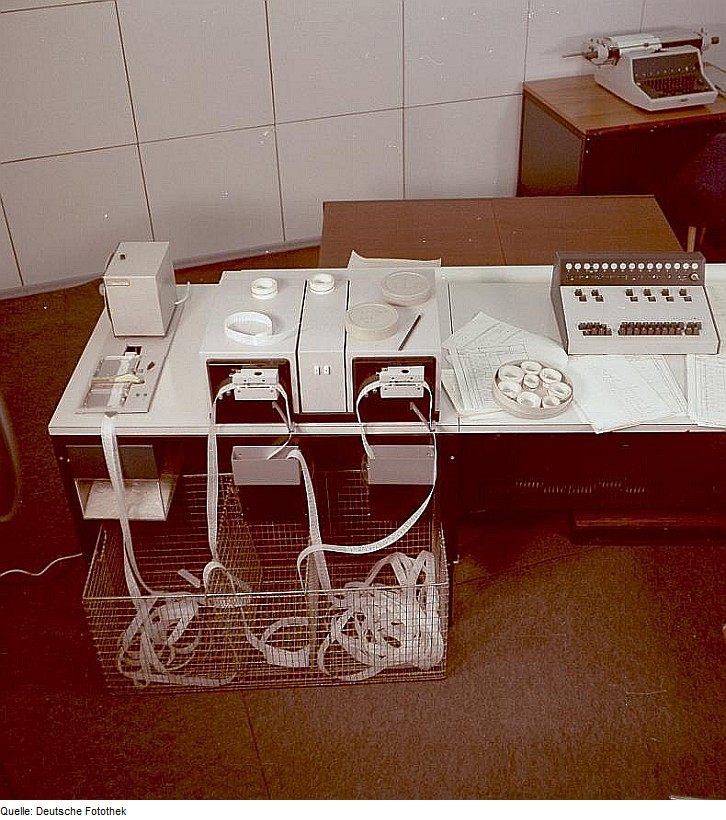
This document will describe what Scheme-langserver did with request-queue.sls.
What does Scheme-langserver hope synchronizing to do?
- To analyze static codes parallel, for rules catching identifiers.
- To respond API requests sequentially.
- Schedule requests and optimize API responses. As this page and this page said, many times we may cancel some requests with editor or by some API semantic definition. A peephole optimization should be applied. This is specifically useful for LunarVim and some other editors’ document synchronizing, for they always produce several
TextDocument/didChangereducible requests.
What mechanism dose Scheme-langserver implement?
Scheme-langserver is supposed to receive requests sequentially but response parallelly. This means all edit operations are mostly about read and write index. And apparently, every write operations occurred sequential with such read interleaving. In addition, multi-threads should be involved at tiller data nodes(like index-node.sls). And the following mechanisms are what we’re using:
- Thread pool with ufo-thread-pool;
- Threaded functions with ufo-threaded-functions;
Why doesn’t Scheme-langserver Use Reader-writer-lock?
As everyone known, reader-writer lock perform following properties. And these make it unlike the other 3 mechanisms, it should be carefully handled to avoid nested locking and many other things.
| Status | Read Request | Write Request |
|---|---|---|
| None | Permit | Permit |
| Has Reader | Permit | Block |
| Has Writer | Block | Block |
Someone supposes scheme-language that workspace.sls and document.sls provide with-(workspace/document/documents)-(read/write) syntax to assure above reader-writer-lock’s properties. A common situation here is that APIs like textDocument/didChange and textDocument/completion may not disturb with each other in scheme-langserver.sls, but they may conflict in document.sls and the situation is much more difficult and exceed the ability of reader-writer-lock.
Because reader-writer-lock actually suppose that requests should be response parallelly as in many web APPs. It’s not trivial, as this page indicated.
Parallel Identifier Catching
With file-linkage.sls, identifier catching is divided into several batches. This means in workspace.sls, threaded-map can easily speed up working.